
The Dorothy & Ward Melville Carriage Museum
Step back in time to a world before cars in our immersive 40,000-square-foot Carriage Museum, home to one of the nation’s largest and finest collections of horse-drawn vehicles. Explore more than 100 historic vehicles on view, along with fascinating carriage-related artifacts, from elegant footmen’s livery to historic firefighter uniforms.
Discover how people traveled before the advent of the car, from the luxurious carriages of wealthy Gilded Age families like the Vanderbilts to practical middle-class family vehicles and purpose-driven commercial wagons, such as a butcher’s cart and a popcorn wagon. Each vehicle offers a fascinating glimpse into the everyday life of people from the past.
As you enter the building and begin your journey, you’ll be welcomed by Grace Darling, a beautifully decorated omnibus and a gem of the Long Island Museum’s collection.
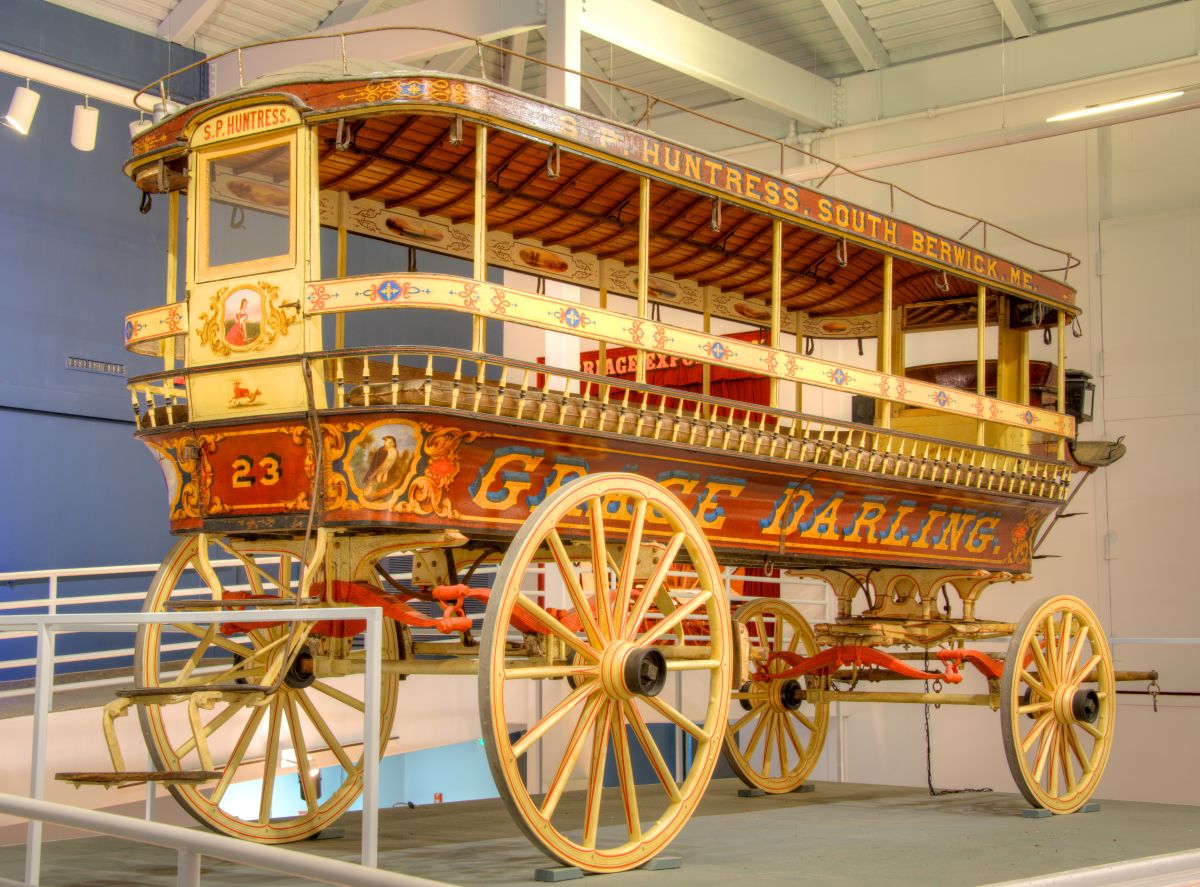
Photo by Brian Kutner
Omnibus or Barge, c. 1880, Concord Carriage Company, Concord, New Hampshire
Decoration attributed to John Burgum, Gift of St. Paul’s School, Concord, New Hampshire
Learn more about this vehicle
In the mid-1800s, this type of multi-passenger horse-drawn vehicle could be found by the thousands on city streets in both Europe and America. Thousands of visitors to coastal Maine enjoyed excursions in the omnibus “Grace Darling,” from the 1880s into the early twentieth century. Later, the vehicle was acquired by St. Paul’s School, Concord, New Hampshire, for use in homecoming parades and such.
FUN FACT: Today’s city bus owes its name to the horse-drawn omnibus. Derived from the Latin word “omni,” meaning “for all,” the omnibus allowed all passengers to ride for a flat fee. The word was eventually shortened to simply “bus”.
The Galleries
Going Places
Carriages came in an amazing assortment of sizes, shapes, and finishes. In our Going Places gallery, visitors will discover some of the vehicles most commonly used from Montauk to Manhattan to move people from place to place, transport goods, demonstrate their owners’ pride and accomplishments, and provide new leisure opportunities.
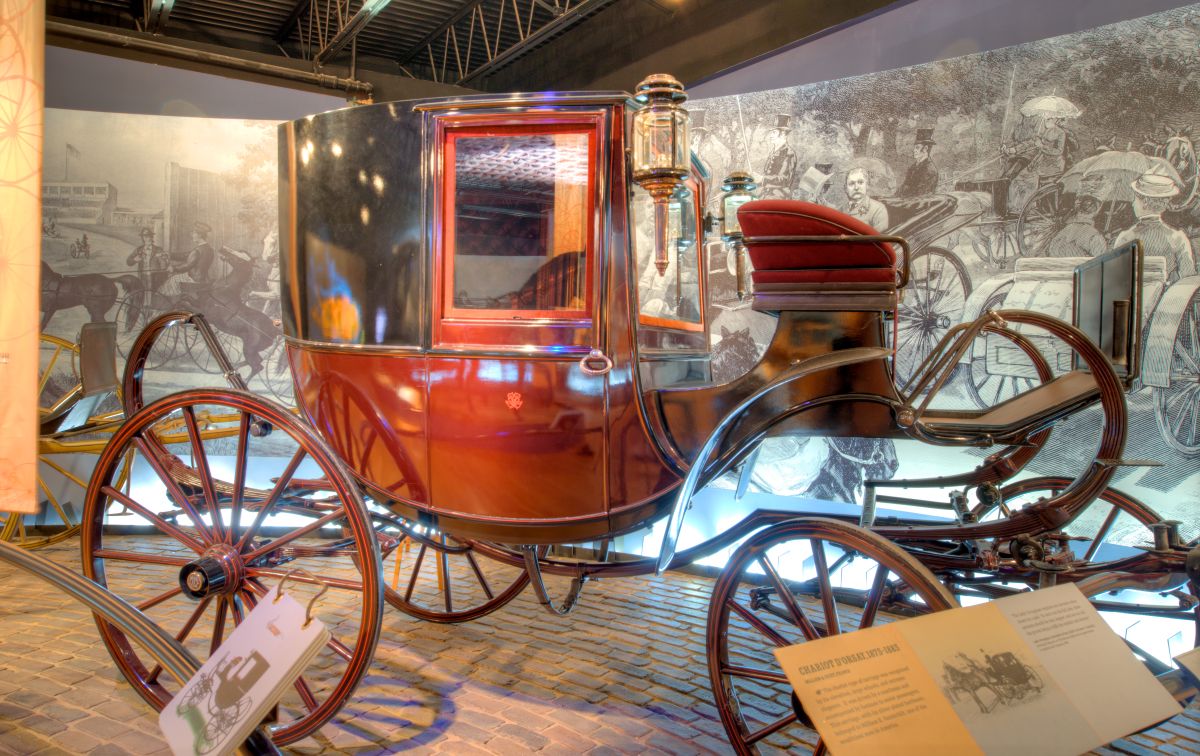
Photo by Brian Kutner
Chariot D’Orsay, 1875 to 1885, Million & Guiet, France
Adopted through a generous contribution by Barbara & Peter Ferentinos through the Museum’s Adopt a Carriage Program in 2015.
Learn more about this vehicle
This highly elegant type of carriage represents the pinnacle of Gilded Age Luxury, driven by a coachman and attended by footmen. Recognized by its elevation, large wheels, and extreme elegance, this Carriage, with its silver–plated hardware, belonged to William K. Vanderbilt, one of the wealthiest men in America.
FUN FACT: Like the luxury cars of today, lavish carriages of the Gilded Age were far more than a mode of transportation—they were a status symbol. But there was one major difference: while today’s luxury car owner primarily pays for the vehicle itself (and, of course, its upkeep), owning an elegant carriage in the Gilded Age meant you had the wealth to support an entire transportation operation, from maintaining a team of horses and to employing coachmen to drive it.
Carriage Exposition
From oil lamps to Edison’s electric lights, from farm buggies to Ford’s Model T, the United States underwent profound changes between the farming/agricultural economy of 1865 and 1918. Factories became the nation’s driving economic force, turning out more goods using less labor at lower prices. The most spectacular display of these new products was at the 1893 Exposition, attended by more than 30 million visitors. Our Carriage Exposition gallery is inspired by the spectacular display of carriages at the 1893 Exposition, highlighting the finest vehicles money could buy and the carriage-making companies that created them.
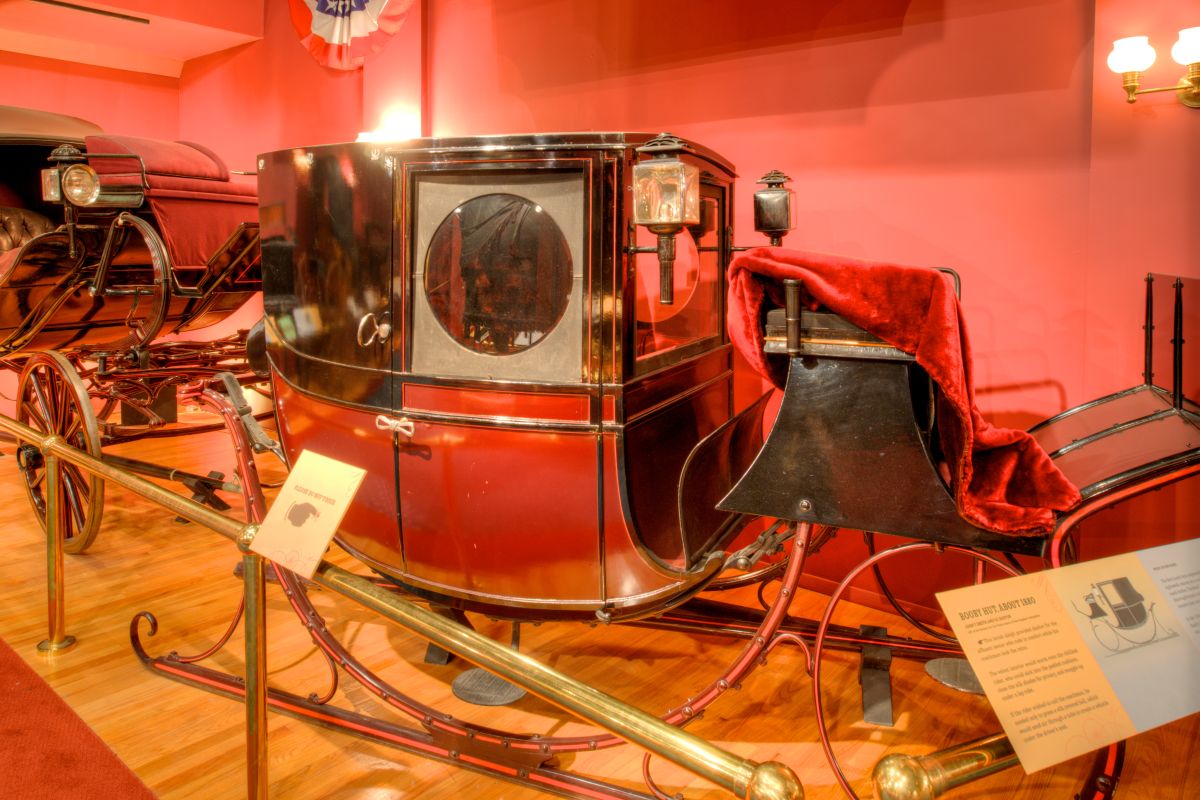
Photo by Brian Kutner
Booby Hut, c. 1800, John P. Smith and Co., Boston
Gift of the Society for the Preservation of New England Antiquities
Learn more about this vehicle
This lavish sleigh provided shelter for the affluent owner who rode in comfort while his coachman took the reins. The velvet interior would warm even the chilliest rider, who could sink into the padded cushions, close the silk shades for privacy, and snuggle up under a lap robe.
FUN FACT: Sleigh bells were more than just the sound of winter holiday cheer—they were an early winter collision warning system. Because a horse-drawn sleigh glides silently over packed snow, bells were mandated by law in many regions to warn of their approach.
Making Carriages: From Hometown Shop to Factory
Carriage production changed drastically during the 19th century. At its start, the manufacturing of carriages occurred almost exclusively in small shops staffed by skilled craftsmen. By the century’s end, however, large mechanized factories had all but replaced small carriage shops. In this gallery, learn how the Studebaker Company changed the economic landscape.
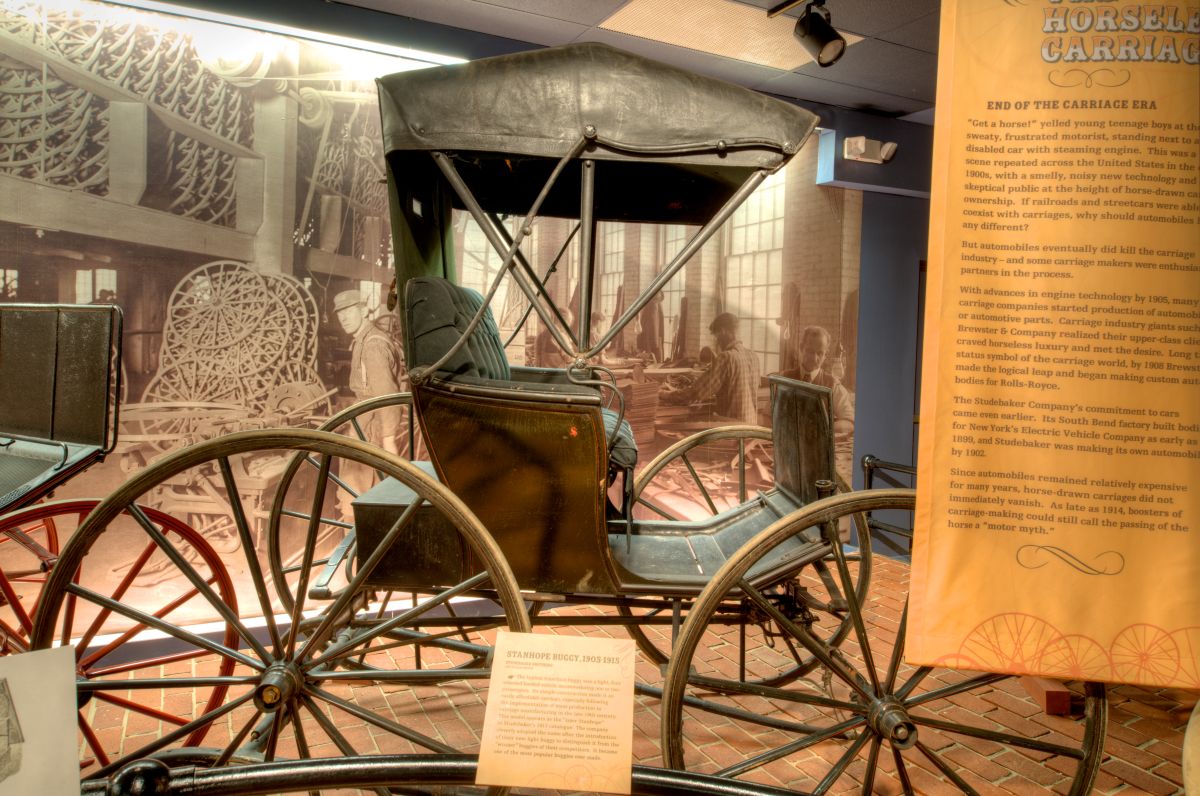
Photo by Brian Kutner
Stanhope Buggy, 1905–1915, Studebaker Brothers
Gift of Joyce Barber
Learn more about this vehicle
The typical American buggy was a light, four wheeled hooded vehicle accommodating one to two passengers. Its simple construction made it an easily affordable carriage, especially following the implementation of mass production in carriage manufacturing in the late 19th century. This model appears as the “Iizzer Stanhope” in Studebaker’s 1913 catalogue. It became one of the most popular buggies ever made.
FUN FACT: When the automobile was first invented, the “Stanhope” name was adapted into an early car body style featuring center tiller-steering, a single bench seat, and a folding cloth top.
Small Carriage Shops
Small-town carriage manufacturers once dotted the American landscape. But as automobiles replaced carriages, they were typically disassembled, and their obsolete contents carted off to junkyards.
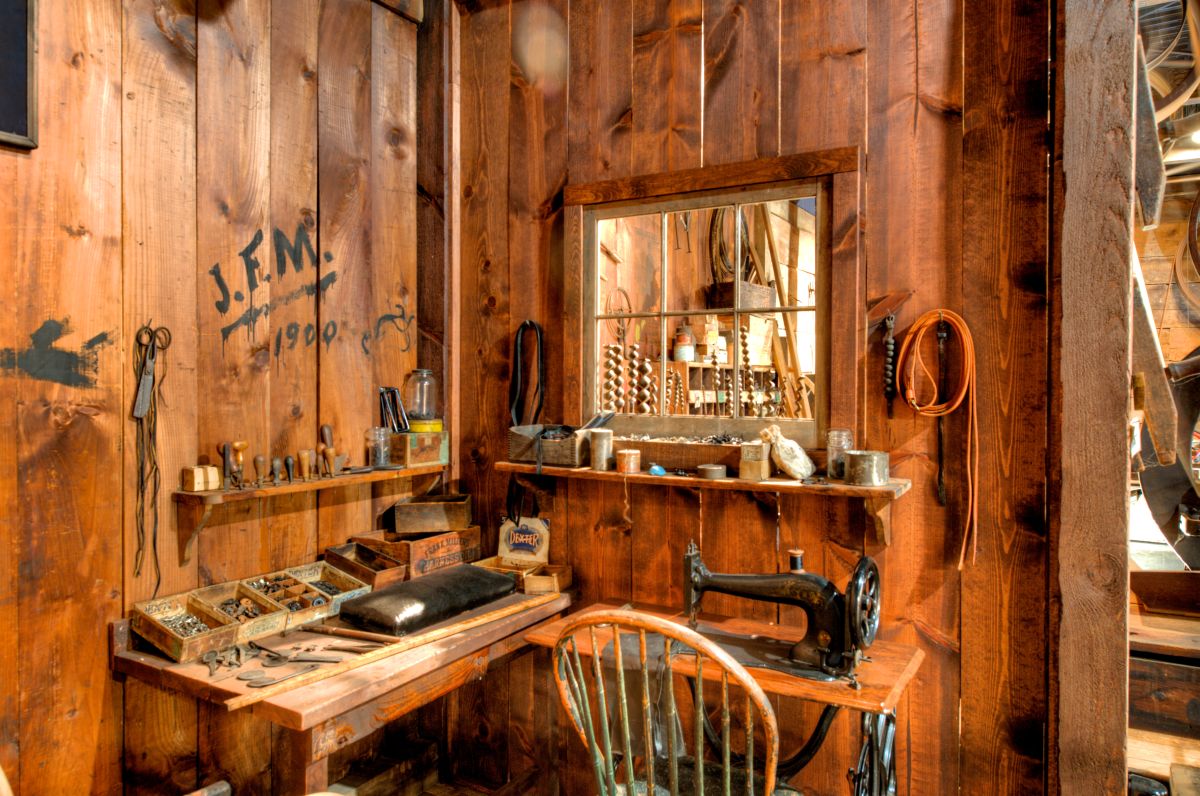
Photo by Brian Kutner
The Graves Carriage Shop, Williamsburg, Massachusetts
Learn More
The Graves Carriage Shop, reinstalled in part in the Carriage Museum, is a remarkable exception. The Graves family began making carriages in the mid-nineteenth century, when Norman Graves, a farmer, started to build and repair horse-drawn vehicles as a sideline. In the 1870s, he built a mechanized shop in the center of Williamsburg, Massachusetts, where he and others who worked with him manufactured buggies, farm equipment, market wagons, and sleighs. The Graves shop remained one of the chief businesses in the small town until the 1920s, when the family opened a separate automobile dealership next door, in effect joining the competition.
The Streets of New York
In the late 1800s, horses and carriages ruled America’s city streets. Step back in time in our Streets of New York gallery to New York City when big horse-drawn omnibuses (the city buses of their day) and hacks (cabs) rumbled over Broadway. Yelling vendors, bellowing stagecoach drivers, and thundering wagon wheels on cobblestones formed the urban soundtrack. Delivery wagons contained fresh groceries, newly-cut lumber, and supplies of every description. Elegant private coaches moved gracefully down Fifth Avenue, carrying rich residents to the office, the opera, or a fancy meal. Heavy steam pumpers put out countless raging fires in the city’s tenements. And many immigrant workers relied on simple two-wheel carts, moved by manpower. New York was also at the center of the carriage-making industry. In 1859, there were over 40 carriage manufacturers in the city, selling nearly 5,000 vehicles per year.
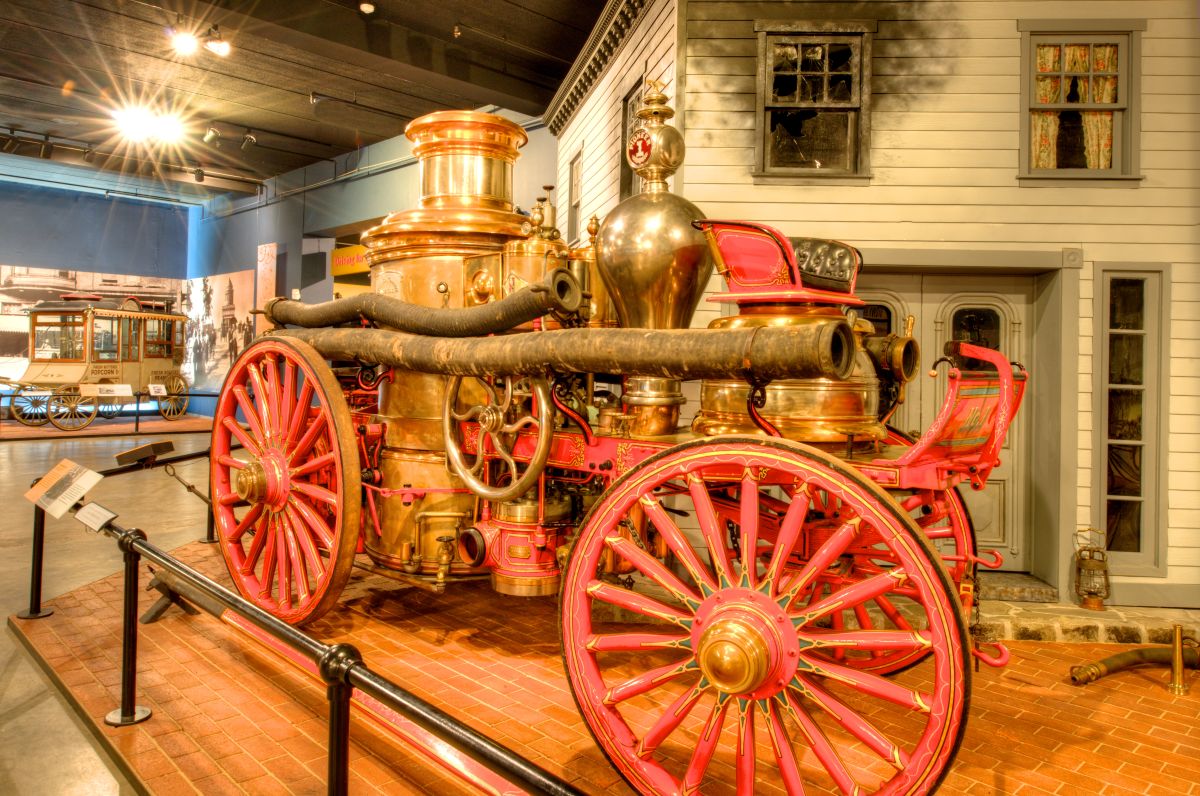
Photo by Brian Kutner
Steam Pumper, 1874, Amoskeag Manufacturing Company, Manchester, New Hampshire
Museum purchase, 1960
Learn more about this vehicle
Although steam pumper technology was available in the United States by 1839, it took a while for it to catch on. Most volunteer departments were skeptical of the new machinery. This eventually changed in many cities, including New York, which organized its first fully functional, professional fire department in 1865 and began using steam pumpers shortly thereafter.
FUN FACT: Fire horses stabled on the ground floor would often climb the stairs to the upper living quarters, attracted by the smell of firefighters’ cooking. Firehouses installed spiral staircases, which horses couldn’t climb. These staircases slowed down response time, which led to a new invention: the fireman’s pole.
NEW! Riding Towards Justice
Visit the newest exhibit in our Carriage Museum, Riding Towards Justice, located within the Streets of New York gallery, which introduces the history of the ancestor of modern urban public transit, the horse-drawn streetcar (also called a horsecar), and invites you to climb onboard! In this powerful exhibition, we learn about the story of Elizabeth Jennings, a young Black schoolteacher, who was forcibly thrown from a streetcar on July 16, 1854. Many horse-drawn streetcar operators refused to allow Black people to board their vehicles. Not intimated, Elizabeth hired a young lawyer—Chester B. Arthur, who later became president of the United States—and pursued a case against the Third Avenue Railway Company. Jennings won, with the judge ruling that “colored persons if sober, well behaved, and free from disease” could not be excluded from public vehicles.
This project was made possible, in part, by the Institute of Museum and Library Services [MA-255428-OMS-24].

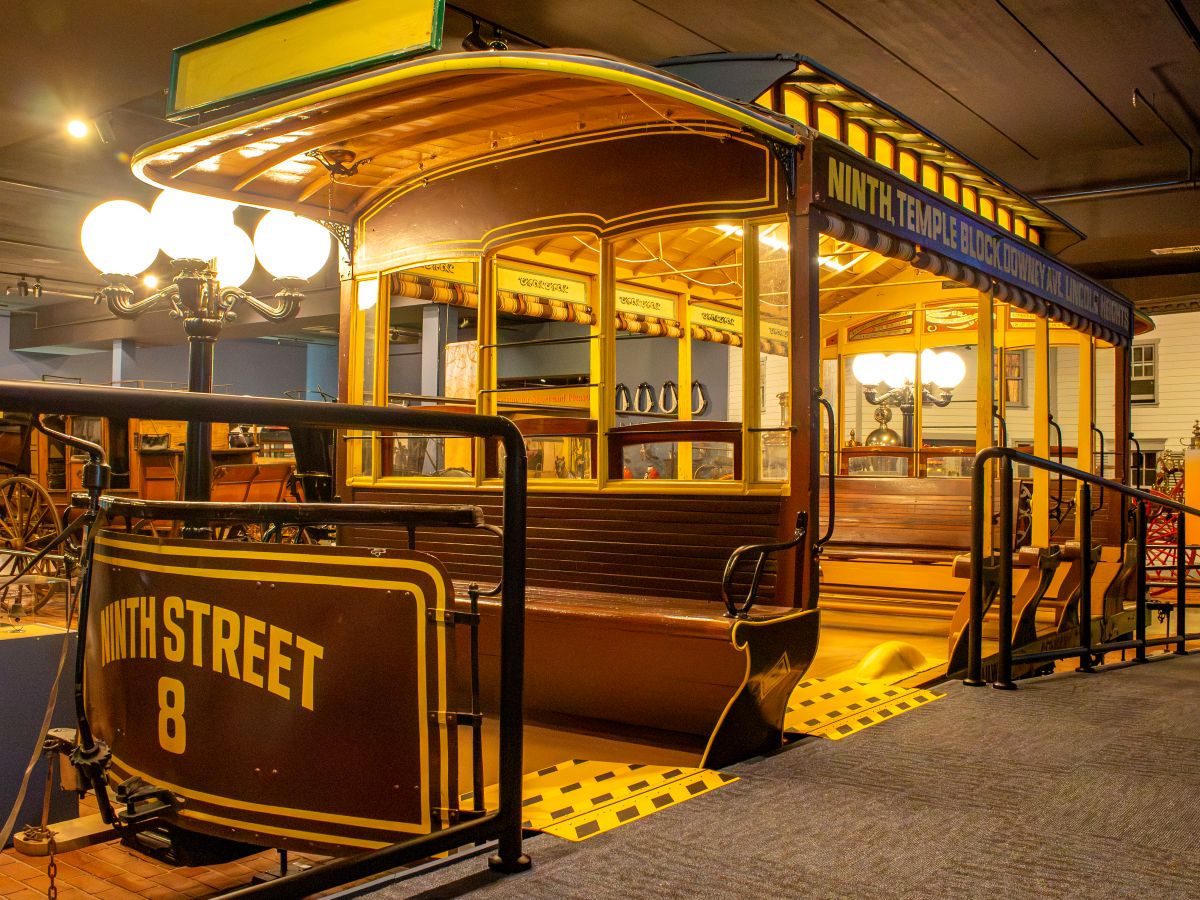
Streetcar, c. 1887, J.G. Brill Company, Philadelphia, Pennsylvania
Donated by Alexander Pollock, Architect, 2019
Learn more about this vehicle
One or two horses pulled this type of vehicle on rails along a regular route down city streets. New York City started the first horsecar line in the US, in 1832. By 1870, New Yorkers were taking more than 100 million horsecar trips a year. In contrast to the smaller, private vehicles in this gallery, the horsecar offered few comforts. Riders shared unpadded wooden benches, with roll-down side curtains offering some protection during inclement weather. But it was cheap, efficient transportation, and facilitated travel between city neighborhoods for people going to work, shopping, and leisure activities.
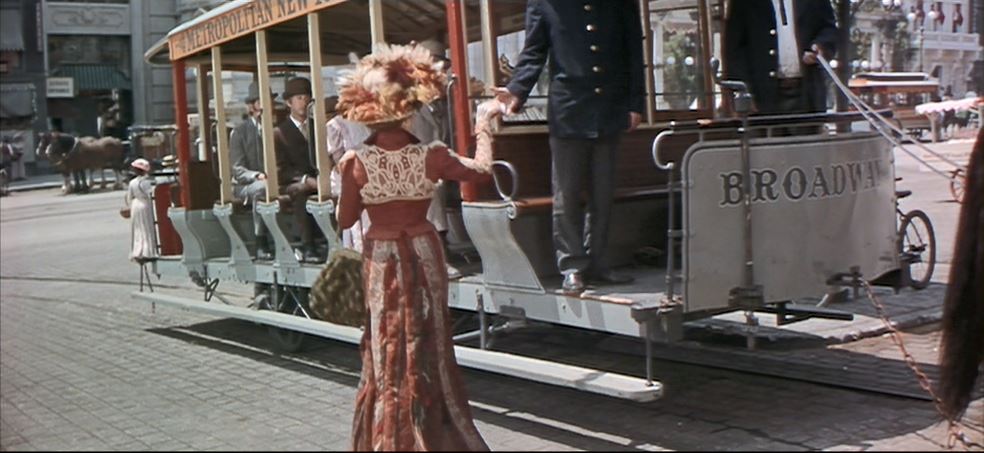
FUN FACT: This very streetcar was screen-used in the film, Hello, Dolly! (1964), starring Barbra Streisand and Walter Matthau.
Little Stony Brook
As you make your way down to the lower level of our Carriage Museum, you can enter and interact with a re-creation of the old Stony Brook Station. The Village housed in our Carriage Museum core consists of two-thirds-scale structures based on local buildings, dating circa 1900. These structures include the Old Stony Brook Post Office, the E. E. Topping Store (Stony Brook), and the Samuel West Blacksmith Shop (Setauket), in addition to the Train Station and the actual Depot Wagon in which turn-of-the-century guests were transported from the Station to Stony Brook and other local villages. Little ones are encouraged to get hands-on with history with costumes and props.
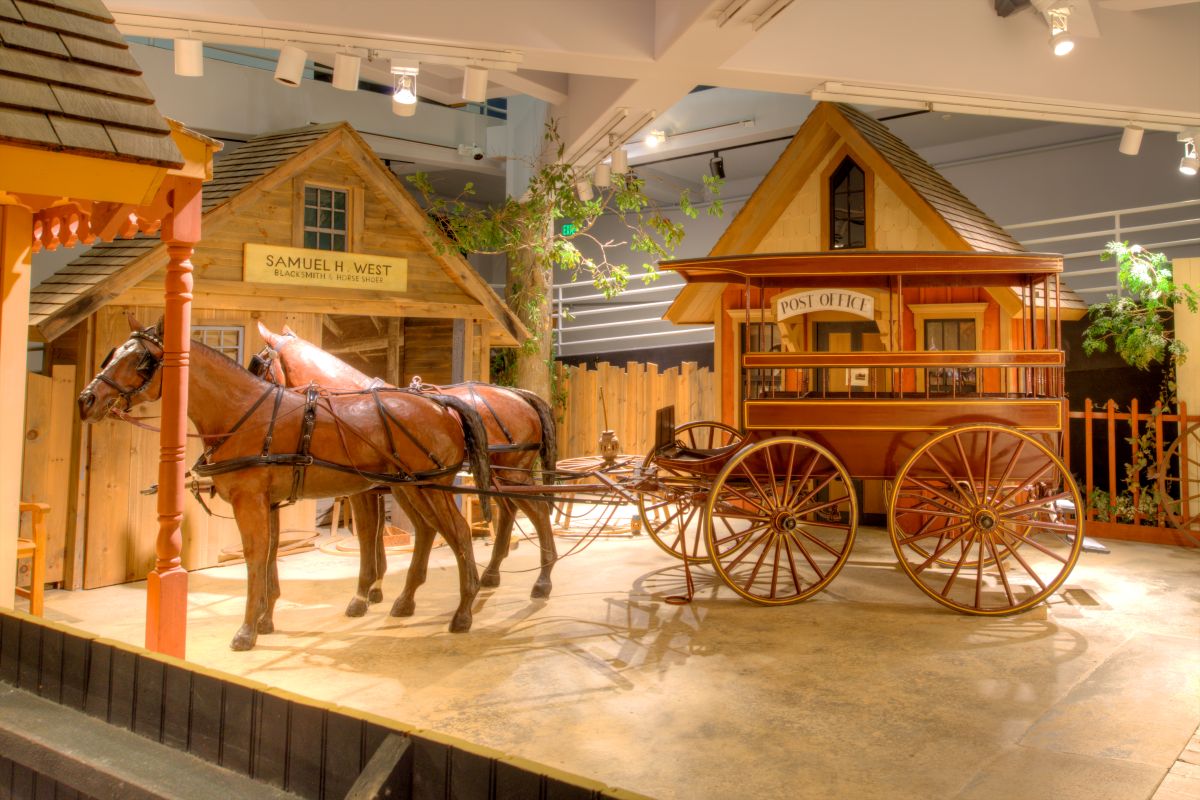
Photo by Brian Kutner
Driving for Sport and Pleasure
Racing at breakneck speed around a curved dirt track…parading in well-appointed splendor through a big city park…sleighing through the snow and ice on a crisp winter’s day–vehicles for sport and pleasure provided escapes into life’s most enjoyable diversions. The vehicles in our Driving for Sport and Pleasure gallery include winter sleighs, pleasure wagons, and other carriages made for carrying well-to-do passengers to fun-filled destinations like resorts and country picnics.
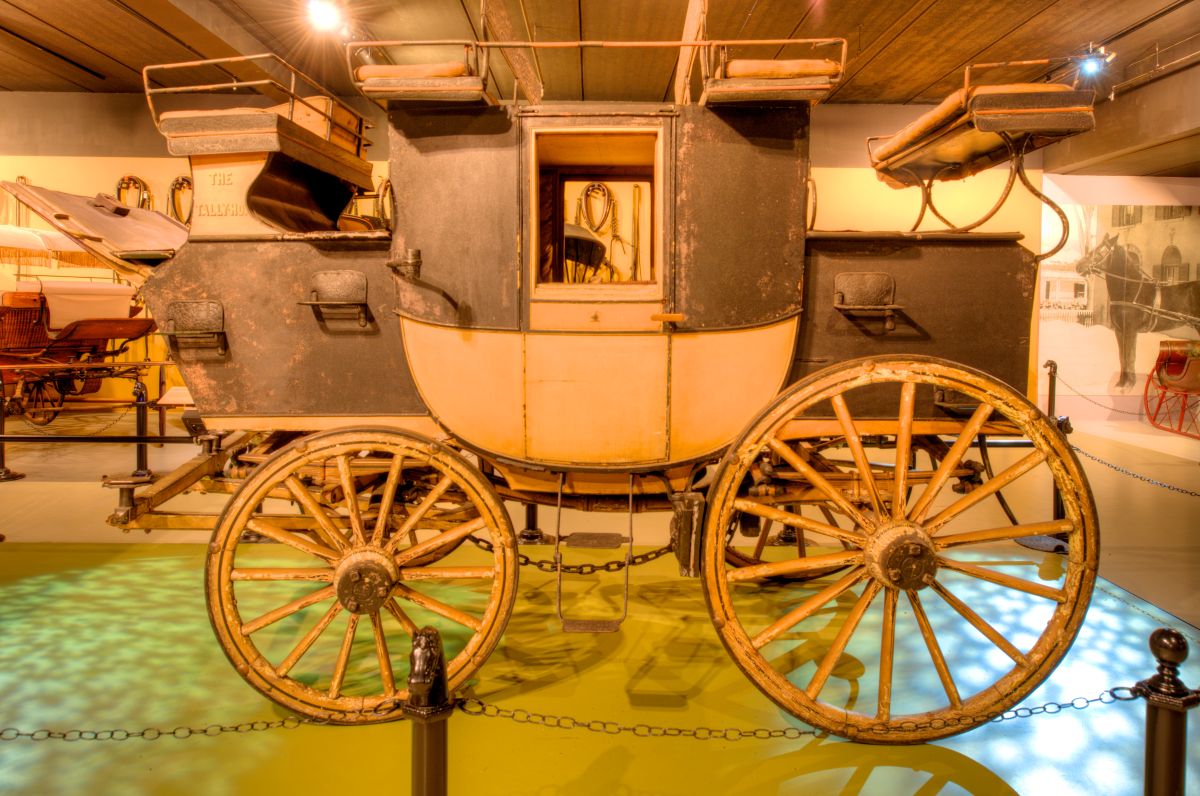
Photo by Brian Kutner
The Tally-Ho, 1875, Holland & Holland, London
Gift of Mrs. Delancey A. Kane through the Museum of the City of New York
Learn more about this vehicle
The Tally-Ho road coach has a unique place in the history of the sport of coaching. The vehicle was brought to this country by Col. Delancey Astor Kane, a founder of the New York Coaching Club. The Tally-Ho was the first purpose-made sporting coach in the country and the desire for something like it soon became the desire of America’s leisured elite. Written about widely in the newspapers and prominent publications, road coaching became a major event, taking hold at a time that many Americans were feeling nostalgic for a seemingly simpler time.
The Tally-Ho, although a gem of the collection, is in major need of conservation. Please consider making a donation at any level to support this unique project. Your funds will be joined with others, as the LIM will also seek additional funding from government agencies, corporations, private foundations and individual donors during the project. Donate Here
FUN FACT: “Tally-ho” originated as a 13th-century French hunting war cry (“taille haut”) but was popularized in 19th-century England as a fast horse-drawn stagecoach. It became famously known during WWII as the battle cry British RAF pilots yelled over the radio to signal they had spotted enemy aircraft. NASA even uses the term when spacecraft or space stations are visually identified.
Gentleman’s Coach House
At a time when the wealthiest 1% owned more than 50% of the nation’s personal property (including many of the largest, most opulent estates on Long Island’s Gold Coast), carriage houses were the ultimate Gilded Age status symbols. But these grand structures did not run themselves. They depended on a huge corps of servants, from the lowest paid and least experienced stable boys to highly skilled older head grooms. Despite coach houses’ splendid outer appearance, the work inside was smelly, noisy, and intense at early and late hours — all reasons why these structures sat a good distance away from the main house. Stepping into our Gentleman’s Coach House gallery, visitors can step back into a replicated coach house complete with a groomsman’s bedroom (currently closed for repairs) and tack room.
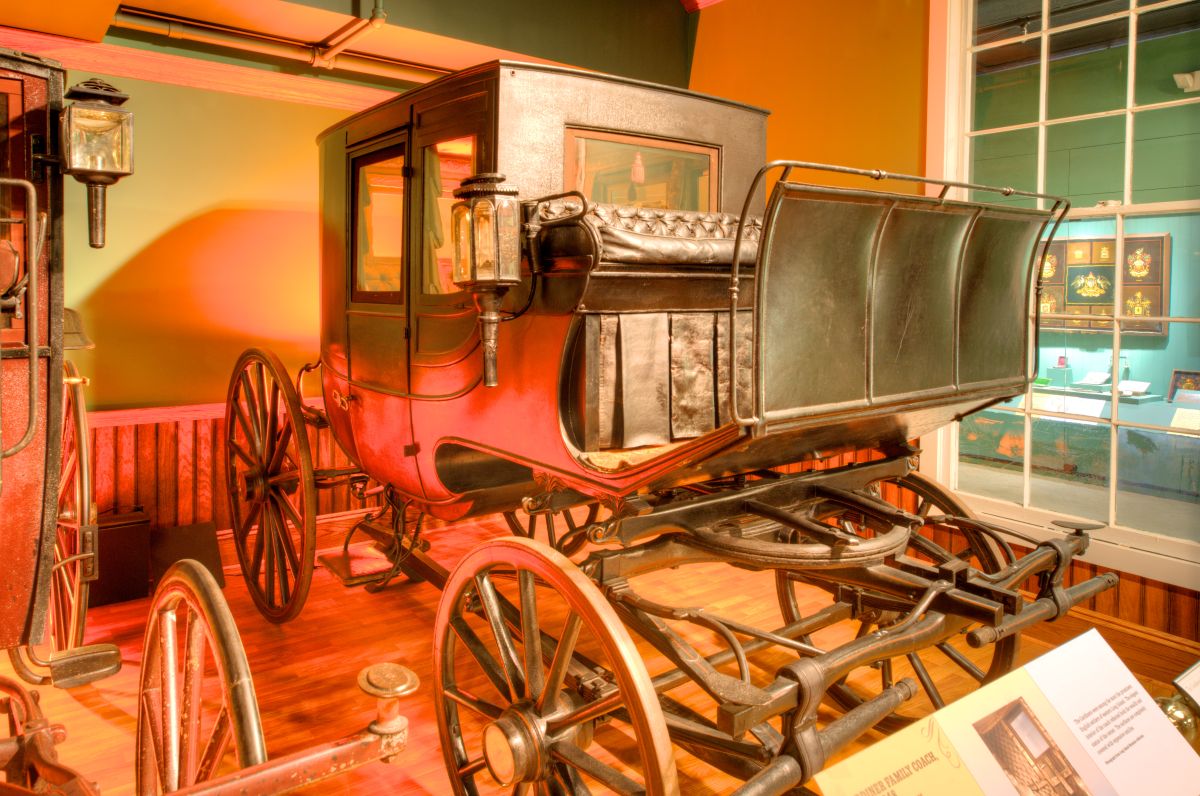
Photo by Brian Kutner
Gardiner Family Coach, c. 1848, James Brewster & Sons, New York
Gift of the Brooklyn Museum of Art. Adopted through a generous contribution by the Robert David Lion Gardiner Foundation, Inc., through the Museum’s Adopt a Carriage program in 2014.
Learn more about this vehicle
The Gardiners were among the most prominent English settlers of eastern Long Island. In the mid-nineteenth century, Gardiner’s Island, on which the family’s ancestral home was located, featured scenic carriage drives on roads paved with pulverized oyster shells and shaded by tall oak trees. Elegant and luxurious, this coach has a design similar to vehicles known as clarences (named after the Duke of Clarence). The interior is trimmed with tufted wool and broad lace and the window slides and handles are carved in ivory.
FUN FACT: Gardiner’s Island has been owned by the Gardiner family and their descendants since 1639. For centuries, horses and carriages were the primary mode of transportation across the island’s 3,318 acres of isolated meadows and old-growth forests.
European Vehicles
From parlors decorated with Old Master paintings to coach houses resembling castles, America’s Gilded Age elites craved European cultural refinements. Indeed, most styles of American luxury vehicles had their origins in the Old World—landaus, calèches, broughams, and chariots d’Orsay, to name a few. Ornate interiors, elaborate paint schemes, and even the coats-of-arms seen on the panels of European coaches were adopted by Americans, in order to associate their vehicles with old money, blue blood and good taste. Most of the European vehicles seen in our European Vehicles gallery were used by aristocrats or high officials on streets and promenades near their palaces and other halls of power and are prime examples of opulence and luxury.
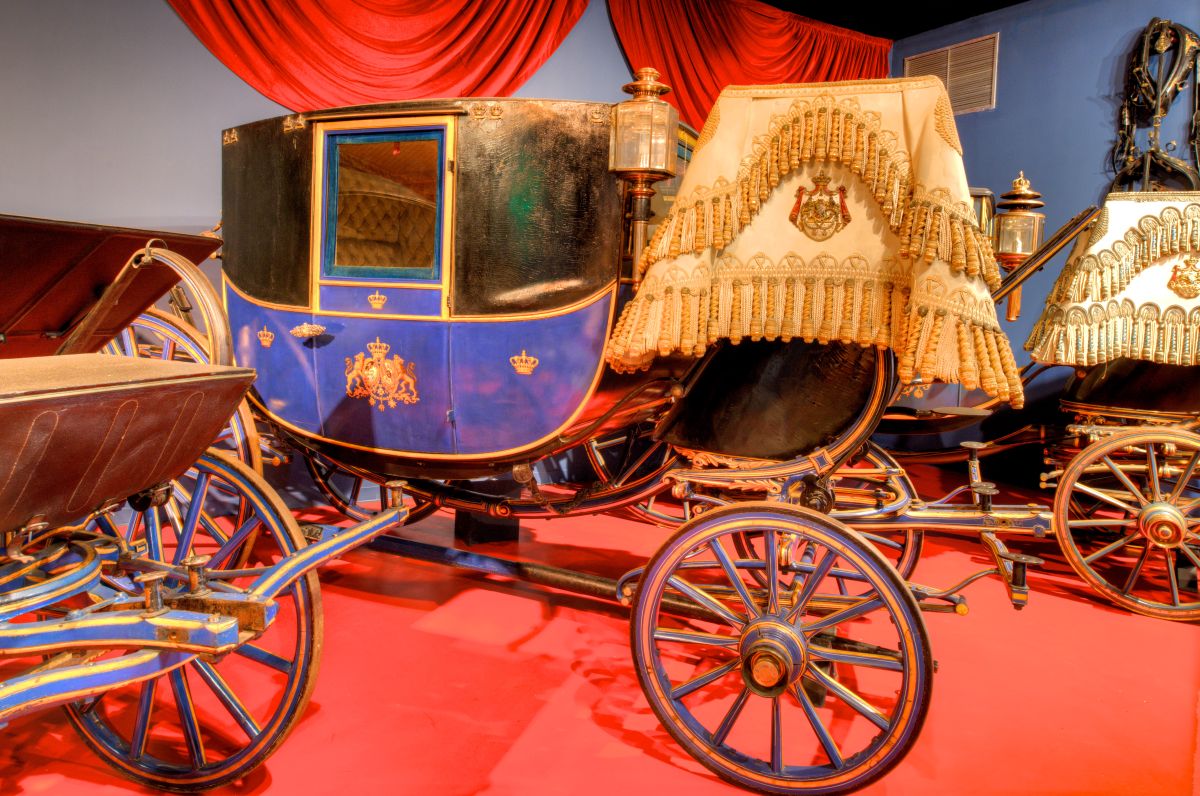
State Coach, c. 1850, M. Staubwasser, Munich, Germany
Gift of Dieter Holterbosch
Learn more about this vehicle
The state coach, a formal vehicle, was used by royalty or high officials in processions and on state business. While state coaches of previous centuries were more lavishly painted and decorated, many nineteenth-century coaches were simplified in appearance in accordance with prevailing tastes. Prince Adalbert and other members of the Wittelsbach family used this vehicle until the Bavarian monarchy was overthrown in 1918.
FUN FACT: The British Gold State Coach (built in 1762) is so notoriously heavy and uncomfortable that monarchs have compared riding it to being “tossed in a rough sea.” Queen Elizabeth II famously called the carriage journey “horrible.”
Riding in Style
Situated at the entry to our lower floor in the Carriage Museum, our Riding in Style gallery features a street scene complete with well-dressed mannequins in late 1800s garments and seasonal props from our History Collection. While the brougham remains the same, the costumes and props are changed out throughout the year.
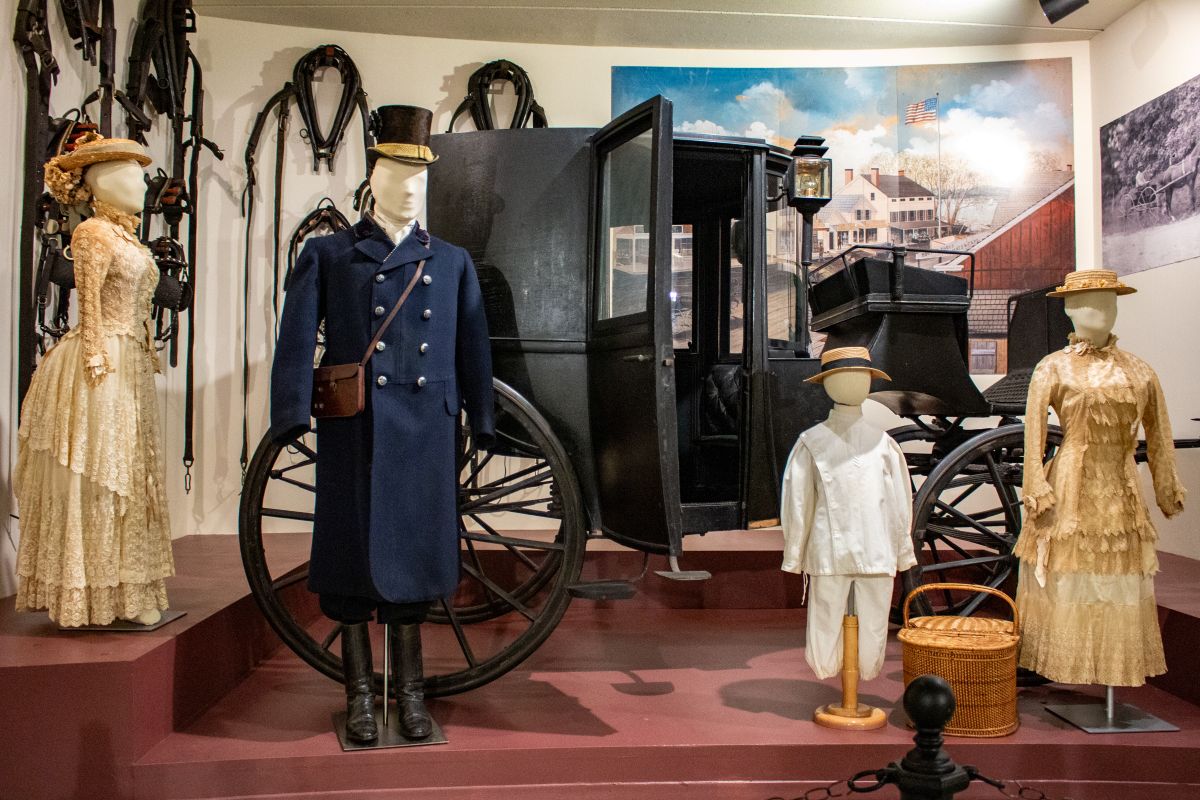
Circular Front Brougham, 1880, Brewster & Company, New York
Gift of Ward Melville
Learn more about this vehicle
Broughams came in many different shapes and sizes. This style of brougham had an extended front end. With an interior elegantly trimmed in leather and broadlace, this vehicle kept its owners comfortable and flaunted their status and personal taste. The inside door panel also features a bell pull that was used to signal the coachman. The prototype of broughams was designed by and named after Lord Peter Henry Brougham of England in 1838. These carriages were enormously popular among private owners but also occasionally used as private cabs for hire in urban areas.
FUN FACT: In the 1960s and 1970s, carmakers like Cadillac and Pontiac started using the “Brougham” name for high-end trim packages aimed at buyers who wanted luxury features without paying top-tier luxury prices. This sparked the “Great Brougham Epoch,” an era defined by vinyl roofs, velour seats, and plush, pillowy rides.

